Showing posts with label Rebecca Ankrah. Show all posts
Showing posts with label Rebecca Ankrah. Show all posts
Thursday, 28 March 2013

Wednesday, 27 March 2013
Evaluation Question 1
In What Ways Does
Your Media Product Use, Develop or Challenge Forms and Conventions of Real Media
Products?
The opening credits of a movie generally involves a series of superimposed text.
There are two characters in the opening of our thriller: the intruder and the victim. The scene opens with the victim, showing her entering her flat, which is about 20 seconds in all. Second, the scene changes to show the intruder going into the same flat, then the camera shows the victim entering the house and going upstairs into her room, and following suit the intruder does the same. The pattern here is that during the opening, the camera shows the victim and the intruder in turn, one after the other which is a common convention of thriller films, an example film would be one such as psycho. This is useful as it enables the audience to make judgement of what is happening at the same time on the side of the victim and intruder. As the distance between the two parties reduces, i.e. the intruder gets closer to the victim, the camera begins to switch between them faster, and the music changes to effect suspense. This technique is a useful and common convention of mainstream media.
All in all, our opening is not very contrary to real media products. We chose not to deviate from traditional styles of thriller films as we did not want to lose the thriller aspect of it, which is the fundamental purpose of the opening. Following the common style of action thriller films gives the audience a chance to predict what might happen and therefore allows them to enjoy it more.
Conventional Film Opening Sequence- Production Complany (Ident)
- Distribution Company (Ident)
- Production Complany (Title)
- Distribution Company (Title)
- Actor 1 (Star)
- Actor 2 (Star)
- FILM TITLE
- Actor 3
- Actor 4
- "
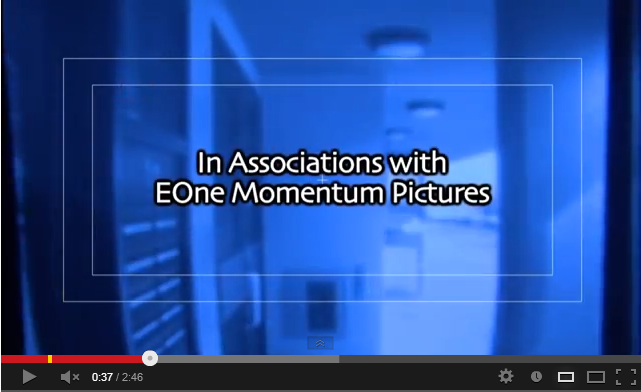
Here are a few examples of the titles in our opening sequence.


The opening credits of a movie generally involves a series of superimposed text.
There are two characters in the opening of our thriller: the intruder and the victim. The scene opens with the victim, showing her entering her flat, which is about 20 seconds in all. Second, the scene changes to show the intruder going into the same flat, then the camera shows the victim entering the house and going upstairs into her room, and following suit the intruder does the same. The pattern here is that during the opening, the camera shows the victim and the intruder in turn, one after the other which is a common convention of thriller films, an example film would be one such as psycho. This is useful as it enables the audience to make judgement of what is happening at the same time on the side of the victim and intruder. As the distance between the two parties reduces, i.e. the intruder gets closer to the victim, the camera begins to switch between them faster, and the music changes to effect suspense. This technique is a useful and common convention of mainstream media.
All in all, our opening is not very contrary to real media products. We chose not to deviate from traditional styles of thriller films as we did not want to lose the thriller aspect of it, which is the fundamental purpose of the opening. Following the common style of action thriller films gives the audience a chance to predict what might happen and therefore allows them to enjoy it more.
Conventional Film Opening Sequence- Production Complany (Ident)
- Distribution Company (Ident)
- Production Complany (Title)
- Distribution Company (Title)
- Actor 1 (Star)
- Actor 2 (Star)
- FILM TITLE
- Actor 3
- Actor 4
- "
-
"
- "
- Casting
- Costume
- Music Supervisor
- Music by
- Edited by
- Production Designer
- Director of Photography
- Executive Producer
- Written by
- Director
This is the general order in which
the Credits of a film are shown. The production Company and the Distributers are
shown first as they're most important, followed by the stars of the film, before
the film title.- "
- Casting
- Costume
- Music Supervisor
- Music by
- Edited by
- Production Designer
- Director of Photography
- Executive Producer
- Written by
- Director
Here are a few examples of the titles in our opening sequence.




Tuesday, 26 March 2013
Evaulation Question 2
How Does Your Media Product Represent Particular Social
Groups?
Representation is the way a social group is shown to an
intended audience. This can be either positive or negative for that social
group. A social group is defined as group where the individuals thereof are
linked by a set of similar beliefs and ideas.
The teenage girl in the film is the targeted victim of the
intruder. Stereotypically she is represented as the good, vulnerable female who
has no power to change what is happening to her. The intruder wears a hoody, trainers
and jeans, all clothing items in your average boy's wardrobe. As the intruder's
hood is up his face cannot be seen. The hood evokes stereotype of anti-social
and gang affiliated behaviour amongst viewers. the attire of the intruders
makes him represent as the 'bad guy', which as it is the intention of the film,
means that we were successful in getting this message across. Having the female
as the good girl and the male as the bad guy is also a stereotype in itself as
crimes are usually attributed to the male gender.
Both the male and female characters ages fits a stereotype:
teenage girl and make-up, and teenage boy and casual dress. Stereotype is often
perceived to be negative but I believe that it is useful and necessary in
driving the plot in the film. Stereotypes allow the audience to make
assumptions which helps them to piece together cues from the film like the
music and the choice of camera shots used. For example long, high pitched
screechy sounds indicate something sinister occurring, whilst over the shoulder
shots indicate that one is being watched. The use of lighting also aids differentiation
in gender representation as when the female is on screen the lighting is
brighter, however when the intruder is being shot the lighting is dimmer.
The victim belongs to the white English social group which
is normally presented in mainstream media as the 'better' race and victim of
foul play by other races. Likewise, the white English teenager is the victim in
'intruder', however this does not go to say that the intruder is of another
race as he is not seen.
Evaluation Question 5
How Did You
Attract/Address Your Audience?
The storyline was simple to make it easy for viewers to tag on to what was happening. Nonetheless, it was realistic for the genre, action thriller which aims to provoke excitement in the audience without being too intellectually demanding. The sue of different camera shots gave it a professional look and made it attractive.

In order to make our thrilling appealing to the target
audience, 16-21 year olds, there were a number of aspects of the film we had to
consider. These were: the storyline, genre of thriller, location of the film,
actors and mise en scene.
The storyline was simple to make it easy for viewers to tag on to what was happening. Nonetheless, it was realistic for the genre, action thriller which aims to provoke excitement in the audience without being too intellectually demanding. The sue of different camera shots gave it a professional look and made it attractive.
The location of the opening was the female victim's home. We
filmed the exterior of the house as well as the staircase, hallway and finally,
the bedroom where most of action happened. The setting was natural for this
character and the mise en scene was already in place as the bedroom already
belonged to a teenage girl, so there wasn't much to do in terms of setting up
the room. For instance, already in place were a dresser with make-up, shoes,
phone, pink covers and curtains to following the style of a typical girly
teenager's bedroom. This similarity with other girls' room is a link to draw
female viewers to watch the thriller
We intended to have the female lead perceived to be an
innocent victim by the audience, and the male perpetrator of the abduction to
be presented in a negative manner. The fact the the actors were within the same
age range of the target audience also plays a role of addressing the audience
as people are likely to tune into something that they can relate to as they can
see a parallel and how it is possible that they may find themselves in a
similar situation.
We used diegetic sounds such as when the female uses her
keys to get into her home and sound of the keypad as she composes a text
message. We also used non-diegetic sound such as the slow high pitched noise to
build up tension and indicate to the audience that the intruder was gaining on
the unsuspecting victim. Non-diegetic sounds were produced on Soundtrack Pro. All
sounds were appropriately included at different parts of the opening to
introduce a sense of reality.
Our film title, 'Intruder' is written in large, bold and
white text. being one word, it does not give away too much information about
the nature of the film other than there may be an intruder. in this way, the
audience's attention is retained as they are curious to find out more about
this intruder and what actually happens.
The production company Candistudios also directly attracts
our target audience as it is a production company specifically for City and
Islington College which has individuals age ranging between 16 and 19, which
falls within the target audience age range of 16-21 years.
This video is brief feedback from our target audience and
our teacher giving opinions of what appealed to them in our thriller opening.
Social networking sites are a great
way to communicate information efficiently and minimal expenditure. Examples of
these networking sites are facebook, twitter and youtube. We posted 'Intruder'
on these mentioned social media sites.

Monday, 25 March 2013
Evaluation Question 4
Who Would Be the Audience For Your Media Product?
Recent surveys have shown 75% of thriller-viewers to be students. There are two main sub-genres of the film genre 'thriller'. These are: action thrillers, and psychological thrillers. Though both sub-genres target a young adult demographic between the ages of 16 and 25, the former sub-genre focuses of the lower ages of that spectrum whilst the latter, psychological thrillers, zones in on the higher end, i.e. 21 and upwards. Therefore, the target audience really depends on the kind of thriller movie that has been created. Psychological thrillers appeal to an older audience because of its intellectual demand. 'Intruder' falls into the sub-genre action thriller because of its simple and easy to follow storyline which makes it suited to an age group of approximately 16-21 years.
Thrillers are appealing to young adults because of the sense of risk associated which is entertaining. People often watch thrillers in social groups which is fun be experienced in a cinema or at home.


I created a facebook profile for a imaginary 'typical' subject of the target audience. The individual is a seventeen year old female student at Woodhouse College named Francesca Indigo who is from Islington. Thrillers have an approximately equal percentage of females and males who watch them, therefore it is suitable that this simulated individual is a female. The fact that she is from Islington- the same place where the film was made - has added benefit because it is more likely that she will express interest in watching the thriller because it was produced in the same place where she is from. She may feel excited that a film has been made in her area and curious to see the quality of film productions where she is from. Subsequently, she may talk about the film with her friends from college through word of mouth, and with a vast college population of hundreds of students, such information would travel fast, hence promoting the film. Having a facebook profile will also facilitate the promotion of the film because as a form of social media, all Francesca's friends can see her comments should she wish to post a review of what she thinks of the Thriller after she has watched it, or even a short statement to inform her friends that there is a Thriller film shot in her area.
Evaulation Question 6
What Have You Learnt About Technologies From The Process of Constructing this Product?
Friday, 8 March 2013

Thursday, 7 March 2013
Editing - Problems with Shooting
This is a short clip of a lighting issue we had whilst filming. It was difficult to balance the lighting in this scene because of the location we were shooting in. If we'd had the lights on, it wouldn't have represented the mise-en-scene well seeing as we were filming one of the intruders(Jameel), scenes which we needed to be dark but still clear enough for us to see what was happening.
This is an example of some poor camera work done by myself towards the ending of our thriller opening. I'd aimed to track the actress as she rose up to standing position after picking up some items then continue filming and she disposed them into her bag before leaving out of her room. The problem occurred because I hadn't turned the camera fast enough, the reason being because of the angle I was stood at. It was hard for me to keep up with the actress while she moved around because of the size of my room and obstacles that couldn't be moved, resulting in me cutting the actress out of the shot most of the time which then went on to give us a little trouble once we began editing. Luckily enough, we'd filmed that particular scene more than once which allowed us to pick and choose the best take I'd filmed but even still, we had to chop up and take out a little part in-between. After this was done, we hit another dead end as we couldn't seem to find a video transition that would allow the sequence to follow on fluently but we got there eventually.
Editing - Deleted Scenes/Examples and Why
 An example of a deleted scene we'd decided not to use would
be the low angle shot of the innocent character's(Billie), feet whilst she got
ready to go out with a friend for the evening. We'd intentional used the
lighting equipment to create the intruders(Jameel), shadow were we'd planned
for him to walk up the corridor and into view of the camera, before hovering in
the background of the clip, creating a cutaway shot which we thought we'd
achieve very well once filmed but realised when were watching our footage back
on the Macs that the additional lighting we'd used to create the shadow had
been turned up to high, making the background bright which then made our initial
idea ineffective.
 Another example of a scene we'd removed from our line of
work would be the high angle shot of the intruder(Jameel), walking up the
stairs after he'd entered the innocent character's(Billie), apartment. We'd shot
this particular scene many time at various different angles and camera shots,
first starting at the bottom of the stairs with a low angle shot and a close up
on his feet as proceeded up the staircase, which was a clip we'd actually used.
Whilst filming we'd planned to use this high angled shot(in the screenshot photo
provided)also but found ourselves deducting it later on because we'd preferred
the shadow shot of the intruder walking across the hallway we'd created using
the lighting equipment and felt it had a more intense feel and related well
with the subject associated with the task given which was to create a thriller
opening. In the same sense, we felt it would permit us with an opportunity in
which we could show some diversity by showcasing an example of the different techniques
we were given the chance to explore.
Overall View of the Project
This experience of
making a film opening for a thriller has given me the opportunity to learn
invaluable truths about: myself and how best I work, working as part of a team,
and it has given me an insight into the industry of film-making and all that
goes into it such as filming, film music, editing etc.
About myself, I've learnt that I am good at using technology as I picked up on how to use the software Final Cut Pro, quickly and efficiently. This enabled me to maximise its use in the making of my film.
Working in a group has taught me the importance of sharing responsibilities but it also taught me how unrealistic it is to believe that all team members would share equal responsibility and work load. However, as the thriller opening is the work of the 'team' and not the individual, I found myself pulling more weight than others in my team, although, I should add, I did have the assistance of one member in my group. Nonetheless, I am thankful that it all came together in the end and having the extra stress of more work gave me a taste of what is to come in the 'real' world.
This brings me on to my next point. This project has made me realise that I would like to have further involvement in such works of film making and editing. This has shown me the commitment and patience required, such as the long hours that this work called for and the less-than-cooperative group members, but the finished product is encouraging and only reiterated that the effort was not in vain. I thoroughly enjoyed this task.
Editing- Final Stages
By the 8th of March, which was the last day given to edit, we'd manage to
finalise almost all aspects needed for our thriller opening. There were minor
things we had to change and make sure they were accurate, for example the
positioning of some of the titles, but our main focus was to complete adding in
the rest of the soundtrack. We spent just over two hours engulfed in these
tasks, but once done, we spent the final 45 minutes to an hour before the
deadline listening to and watching our thriller opening repeatedly to see if anything
needed some last minute adjusting or improving.


One thing we did pick up was the pace in which the titles were made to appear. We felt that they emerged and stayed on the screen for far too long before departing, so we shorted the length and made it so they were on just long enough for the audience to read clearly. Doing this particular task also allowed me(Rebecca), to be at total awareness of the mise-en-scene which also then gave me an idea of how we could perhaps make the titles more effective by changing the pace yet again but only in certain parts of the opening. For example, after the intruder has entered the house and has began walking up the stairs, we made it so that the titles became slightly shorter in both the distance between each title and in the length they were sustained on screen. We felt this merged well with what was going on visually in this part of the sequence between the short cuts of the clips, representing the growing tension being built accompanied by the rising intensity of the music, before regaining its normal speed when it'd seemed like things had relaxed in the sequence.


One thing we did pick up was the pace in which the titles were made to appear. We felt that they emerged and stayed on the screen for far too long before departing, so we shorted the length and made it so they were on just long enough for the audience to read clearly. Doing this particular task also allowed me(Rebecca), to be at total awareness of the mise-en-scene which also then gave me an idea of how we could perhaps make the titles more effective by changing the pace yet again but only in certain parts of the opening. For example, after the intruder has entered the house and has began walking up the stairs, we made it so that the titles became slightly shorter in both the distance between each title and in the length they were sustained on screen. We felt this merged well with what was going on visually in this part of the sequence between the short cuts of the clips, representing the growing tension being built accompanied by the rising intensity of the music, before regaining its normal speed when it'd seemed like things had relaxed in the sequence.
Wednesday, 6 March 2013
Editing on the 6th and 7th of March
On the 6th and the 7th of March Umme and I (Rebecca)
returned to room 325 to continue with the editing for our thriller opening for
the majority of both days. During this time we worked on adding our titles to
our sequence as well as finding the right sounds to accompany it.


In addition to this, we'd originally had the title of our action thriller in a bright red colour, but later decided on changing it to white as we felt that the red contrasted too much with the colour of the room which was mostly pink. (Because of Rebecca's pink ceiling light shade).
During the process of uploading the titles we decided on a
font size as shown in the image below. We didn't want the font to be too small
that you wouldn't be able to read it properly when it is being displayed a large
screen, nor did we want it to be too big that it became overpowering and a
distraction from what going on in the opening, therefore, we settle for font
size 30 which we felt was the most suitable. We also decided to add effects on
the title, thereby allowing the titles to dissolve on then off the screen with fluency.
The video transition we opted for was Cross Dissolve.


In addition to this, we'd originally had the title of our action thriller in a bright red colour, but later decided on changing it to white as we felt that the red contrasted too much with the colour of the room which was mostly pink. (Because of Rebecca's pink ceiling light shade).
 |
| This was the colour of the title before we changed it. |
 |
| This is what the title looks like now. |
 |
| This image shows the soundtrack that we added today (7th March) on to our timeline |
Tuesday, 5 March 2013
Editing - Creating Sound
For our thriller opening we experimented mainly with
different sounds found using Soundtrack Pro, a music composing and audio
editing application made by Apple Inc. We found the overall process a little
difficult at first, trying to create the right sound and finding different
elements that would work well with our piece. It took a while but we soon
concluded and collectively agreed that it may not be idle to have the
soundtrack running the whole way through our opening, considering the various
amount of cuts and clip changes between the different setting, we opted to have
elements of Foley sound as well as slow paced tension filled reverberation and echoed
sounds in parts were the scenes are dark, as it represents and goes well with what's
been shown on the screen. In the same way we thought it'd also be a good idea to
apply no sound at all in other places, for example when the character that is unaware
of the intrusion
taking place in her home is shown entering her room, therefore
highlighting her innocence. We also thought of an idea where we'd maybe add in
a recorded radio station piece, using it as part of the background music, again,
in attempts to create a casual and normal everyday setting in which the innocent
character is trying to portray.


 |
| This is a screenshot of the sound tracks that we put together on Soundtrack Pro |
Editing on the 4th and 5th of March
On the 4th and the 5th of March, Umme and I (Rebecca)
returned to workshop from 3pm until 5pm (on Monday) and spent the whole day Tuesday
working on our thriller opening. Our main force on both days were to begin
shorting our opening as it had reached 3mins and 30seconds after our first
attempts to create a complete sequence. We had to collectively decide on which
parts where most important, as well as figuring out what exactly we wanted our
views to see and what will keep them interested. To achieve this effectively,
in addition to removing clips, we also had to cut, replace and rearrange our
clips, speeding up the most tedious sections but in such a way that it'd still
flow as a complete piece and still make sense, as well as slowing down the
tempo in other sections, aiming to creating tension. In these two days, we also
agreed on fonts that we'd possibly use for our titles.
During the process of editing over these two days, we also took into consideration the effects we were using in-between cuts and transitions, such as Dip to Colour and Fade in Fade Out, which was mainly used when focusing on the innocent character, as opposed to the hard cuts and transitions used on the villain. The contrast when dealing with the lighting was also an important aspect we'd had to master when editing although luckily for us, there wasn't much adjusting to do. We also found the Cross Cut transition extremely useful when attempting to piece together similar clips in an efficient and interesting way.
 |
| This is an example where we changed our clips around. We decided that spitting up the each clip twice and rearranged helped build more suspense and looked more effective. |
During the process of editing over these two days, we also took into consideration the effects we were using in-between cuts and transitions, such as Dip to Colour and Fade in Fade Out, which was mainly used when focusing on the innocent character, as opposed to the hard cuts and transitions used on the villain. The contrast when dealing with the lighting was also an important aspect we'd had to master when editing although luckily for us, there wasn't much adjusting to do. We also found the Cross Cut transition extremely useful when attempting to piece together similar clips in an efficient and interesting way.
Friday, 1 March 2013
Editing - Process Of Editing
Once we'd completed shooting all our footage we began editing, starting on
the 25th of February using Final Cut Pro, a non-lineal video editing software. We
started by firstly sorting out the shots we filmed over the two days, excluding
the shots we weren't going to use from the shots we were either going to use or
may have considered using. This process alone took a while considering we'd
filmed quiet a lot of shots at a wide range of different angles, thereby providing
us with more options to choose from, depending on which parts had turned out
the best.
After we'd chosen our clips, we went on to create the sequence. Whilst doing so we found ourselves swapping some scenes around having realised it would potentially transpire better than our original set ideas on how we wanted, clip by clip, our end product to be viewed.


On our second day of editing which was on the 26th of February, we continued with added more clips to the time line, also adding video transition effects as we went along and were happy to see our work beginning to take shape.

Between the 27th and the 28th of February we aimed to finish our rough cut version of our thriller opening, however we did not manage the task completely as there was no sound nor were there any titles attached to our sequence. Since we hadn't blogged at all on the editing process, once we'd gained feedback on our efforts so far, we discussed who'd do which posts before we resumed editing on the 1st of March.
As we continued editing along the days between our Media lessons and workshop, as well as during our spare time, we soon found ourselves going back to the drawing board, looking through all our original footage from both filming days, adding in clips we'd previously planned to discard, either because we needed to create a change in scenery to build up the suspense and tension between two similar scenes, almost as if using it as a video transition, thereby also creating silken fluidity throughout the scenes, or, for example, towards the very end of our thriller opening where we added in a deleted scene we'd initially planned on using somewhere within the very beginning when planning or sequence, realising we needed something else in-between the last two clips that allowed them to combine in such a way that it wouldn't come across as if there'd been thrown together randomly. Most clips we found were fairly long considering we'd only been given two minutes in which were to create the entire opening thriller opening, therefore guarantying us an huge amount of editing to do to make the clips shorter and precise, which required a lot of patience and persistence.
After we'd chosen our clips, we went on to create the sequence. Whilst doing so we found ourselves swapping some scenes around having realised it would potentially transpire better than our original set ideas on how we wanted, clip by clip, our end product to be viewed.

On our second day of editing which was on the 26th of February, we continued with added more clips to the time line, also adding video transition effects as we went along and were happy to see our work beginning to take shape.

Between the 27th and the 28th of February we aimed to finish our rough cut version of our thriller opening, however we did not manage the task completely as there was no sound nor were there any titles attached to our sequence. Since we hadn't blogged at all on the editing process, once we'd gained feedback on our efforts so far, we discussed who'd do which posts before we resumed editing on the 1st of March.
As we continued editing along the days between our Media lessons and workshop, as well as during our spare time, we soon found ourselves going back to the drawing board, looking through all our original footage from both filming days, adding in clips we'd previously planned to discard, either because we needed to create a change in scenery to build up the suspense and tension between two similar scenes, almost as if using it as a video transition, thereby also creating silken fluidity throughout the scenes, or, for example, towards the very end of our thriller opening where we added in a deleted scene we'd initially planned on using somewhere within the very beginning when planning or sequence, realising we needed something else in-between the last two clips that allowed them to combine in such a way that it wouldn't come across as if there'd been thrown together randomly. Most clips we found were fairly long considering we'd only been given two minutes in which were to create the entire opening thriller opening, therefore guarantying us an huge amount of editing to do to make the clips shorter and precise, which required a lot of patience and persistence.
Editing- Order Of Titles
Production Company (Ident) - CANDI MEDIA Studio
Distribution Company (Ident) - EOne Momentum Pictures
Production Company (Title) - CANDI MEDIA Studio
Distribution Company (Title) - EOne Momentum Pictures
Actor 1 - Jameel Lowe
Actor 2 - Billie May Mason
Film Title - INTRUDER
Actor 3 - Harlem Hansworth
Actor 4 - Tori James
Actors 5 - with Daniel Banks
Casting - India Erin
Costume - Sharron Gibbs
Music By - Umme Hannee
Edited By - Rebecca Ankrah
Production Designer - Courtney Lewis
Director of Photography - Graham Browne
Executive Producer - Jason Read
Director - Ashley Campbell
For our thriller opening we've decided to use the original convention order in which film titles usually appear on screen. In reference to the Distribution Company, we'd originally used the Distribution Company MGM, (Metropolitan Groove Merchants), only to come to realise that company was rather large and established and maybe a little to elite for our thriller opening, so instead opted for the Distribution Company, EOne Momentum Pictures, as it is all the more relatable, being one of the leading independent motion pictures distributors in the UK, most know for the films such as 'The King's Speech', 'Amelie', and 'Eternal Sunshine of the Spotless Mind', to name a few. In relations to the title names, we decided as a group to make them up, all apart from four main parts which we've taken credit for.
Editing- Rough Cut feedback
Once we'd gained feedback on the rough cut of our thriller opening, we discussed the opinions we'd be given, both good and bad, keeping them in mind when we resumed editing. An example of criticism we'd received was on the length of our opening scene. The need for it to be shorted was stressed, as well as the idea of maybe rearranging certain clips and creating more diverse cuts in attempts to make it more interesting, although overall the majority of our peers and our teacher Marisa seemed to enjoy it and liked where we were going with the ideas and concept, quote, 'It a very good piece, very impressed' Marissa commented. She also gave us editing tips in reference to the effects we could possibly use to emphasize a particular CCTV clip in the very beginning of our thriller opening, as well as point out along with Ujol (a peer) who commented on the successfulness of the opening scene, even without any sound and suggested maybe keeping that silence in certain places.
As mentioned, in our rough cut we had no sound nor did we have any titles so that had been our main concern, as well as adjusting a few jump cuts and tracking issues that'd been picked up by Dan and Marisa (our media teachers). We plan to achieve this over the following dates; the 4th - 8th of March. We aim to complete our final thriller opening by the 7th, leaving us an extra day before the deadline to tweak and change any last minute features if needed.
Editing- Rough Cut
This is the rough cut to our thriller opening however we
weren't able to complete it therefore there are very few titles and no
soundtrack but we did manage to add in effects and chain together a complete
sequence. The length of our piece also surpasses to limited time given.
Editing- Evidence of Constructing Timeline
Using Final Cut Pro, we were able to put together a well constricted
timeline. To begin with, we sorted out our footage, separating the clips we
were liking to use from the clips we didn't want to include. We then went on to
name the clips, using basic abbreviated sentences therefore allowing us to
identify the clips by name, quickly and efficiently. From the very start of the
process, we had to cut some clips either short of within the middle, taking out
little amounts before using either a transition, an effect or completely
different clip as a default, either because the clip was too long, there were
mistakes in-between or because we wanted to add dimension and variety to our
piece by varying the shots, shot types and by playing around with the order our
sequence.
The story board we'd previously created also helped when constructing our timeline.
The story board we'd previously created also helped when constructing our timeline.


Subscribe to:
Posts (Atom)